You’re invited!
The Gala Reception will be Friday the 13th of Jan from 8-10 p.m. in the main hall at the Ferry Building in San Francisco, California.
Marketplace will showcase the winners on Sat the 14th from 8 a.m. to 2 p.m. in the Front Alcoves of the Ferry Building.
So put it on your calendar and hop online now to book some tickets. You know you’ve been looking for a good excuse to fly to SF for a good coffee/roaster crawl weekend.
Click here For more info from the Good Food Awards site and here to purchase a Reception or Marketplace ticket.
Happy New Year!
-Edwin
Good Food Awards 2012
December 29, 2011
You’re invited!
The Gala Reception will be Friday the 13th of Jan from 8-10 p.m. in the main hall at the Ferry Building in San Francisco, California.
Marketplace will showcase the winners on Sat the 14th from 8 a.m. to 2 p.m. in the Front Alcoves of the Ferry Building.
So put it on your calendar and hop online now to book some tickets. You know you’ve been looking for a good excuse to fly to SF for a good coffee/roaster crawl weekend.
Click here For more info from the Good Food Awards site and here to purchase a Reception or Marketplace ticket.
Happy New Year!
-Edwin
Changes at FVH
November 30, 2011
Yes, it’s been a while since I’ve posted on this blog. Almost a year and a half. Tempted to say it’s been too long, but it’s not been long enough. While technology has many great values it can also be a huge waste of time. With over 1400 contacts in my phone and an email inbox that is evidence of how poorly I manage time, it is hard to justify spending time adding a new post. However I find it does have it’s place. It can build brand, establish history and take up space on servers. It was Jen and Chris the founders of Victrola that convinced me blogging was quite easy to do, this was back when the then tonx.org (now at http://blog.tonx.org sort of…) was one of the first blogs in specialty coffee with pictures and interesting content. Interesting to me anyway. Tony happened to work at Victrola as their roaster. At the time the only roaster I knew that blogged. And now it’s hard to think of one that does not at least tweet.
So I decided to dive in since it seemed no one else was doing it. I’m fascinated with the advantages and risks of being an early adopter. This was when Myspace was much bigger than Facebook and Twitter was barely an idea in Jack Dorsey’s head. I soon realized there was no end to how many people had seemingly infinite time to post on their blogs.. that kept popping up left and right. It became hard to keep up on 65 different blogs and tools emerged to make this easier. And that’s about when I felt less compelled by what I was reading. Not because there wasn’t compelling content out there. It was the amounts of noise and babble that drowned out the nuggets of information that were worth digging for. As the audience grew so did the disconnect. SO WHAT DOES ANY OF THIS HAVE TO DO WITH F.V.H.? Well we’ve been fortunate to get quite connected in record time for a farm that is MUCH smaller than most imagine. Shockingly so to anyone who visits. For a farm that is 7 hours away from Guatemala City. Half our customers can fly to Guatemala faster than we can get Guatemala city to the farm! So it is nothing short of a miracle that anyone knows about FVH today. One could speculate it is a collision of luck and strategy with really good timing.
For several years now we have been working hard to get less connected. Simply to sell more of our coffee to less people. To bring less people to the farm but be much more intentional regarding who and why. And this comes around to defining clarity and purpose in what we are working towards. We want to produce some of the finest coffee in the world and then we want people to enjoy it. And really this is what every producer wants. This is a lot of work though. Two months ago we went with out our manager for a full week as Eliseo cupped hundreds of defective coffees each day as part of an intensive cupping course for producers taught by an old colleague and Q grader. We are going to be doing a lot of cupping on the farm in 2012. Something we’ve not done before because I’m simply not motivated to try and do something if it can’t be done really well. We have not been equipped to do this well in the past. This is changing. We will get our patio crew cupping in between turning and drying coffee on the patios. We have dozens of neighboring farms bringing their coffee for feedback and now we’ll equip them to create their own feedback. We are surrounded by farms that have been in the Cup of Excellence and have been awarded high marks for quality by many private organizations such as exporters, importers, roasters, retailers as well as by Anacafe. Simply talking about the difference and showing pictures of what a ripe cherry looks like is not as big an impact as being able to taste the difference and BE the consumer.
Over the last 10 years the single most frustrating thing as a producer and as a consultant to roasters is seeing value added that goes unappreciated. (the only thing worse of course is to under deliver) I picture getting a perfect haircut and then having the barber tell me, “you know Edwin I did such a great job cutting your hair, I’m going to go through the motions once again if you don’t mind” Well, that’s pointless and yet we do this in coffee all the time. If the end consumer does not perceive the same added value you do, then it is not there. For example, bad coffee in fine dining is not a problem to be solved. The problem is the consumer does not know the difference so how can they be expected to care? So we are getting our hands dirty with the end goal of continuous education and ever improving quality. Starting on the farm.! We hope you are able to enjoy the fruit of our labor! Stay tuned as there are more changes to come in the next few months. Nothing big really, but a lot of little things that we think make a difference.
-Edwin Martinez
Difficult times in Guatemala – May/June 2010
June 1, 2010
President Colom has declared Guatemala in a state of “national calamity” after an earthquake, an errupting volcano, the capital being covered in raining black sand and a tropical depression hitting the northwest coast.
After more phone calls and emails than usual and over 1000 views just this morning to a blog I’ve only posted on once this year… I thought I should give an update with a quick summary of some links.
In ENGLISH:

In SPANISH from PRENSA LIBRE:
Every few hours these numbers seem to go up, but it’s currently over 115,000 who have been evacuated or are stranded due to over 100 landslides, 18 major bridges destroyed and over 100 bridges including minor bridges on dirt roads and footpaths that hinder daily life and commerce. 152 have died 90 missing.
22,000 homes damaged or destroyed
Largest highways in the country shut down
Another sinkhole. 100 ft deep in the middle of a densely populated neighborhood. This is in addition to the one I posted 3 years ago here
Food shortage in northwest region in and around Huehue due to damage from heavy waters
How are we at FVH? Well many roads are damaged and this will make transport challenging. We are fine. As a people the community is doing well. I am in touch with Eliceo who is in charge at the finca. And aside from not seeing the sun for 2 weeks straight all is o.k. I look forward to sharing more Eliceo soon. I just returned from Guatemala back to Bellingham 2 weeks ago and might have returned Friday morning to catch the final day of the Cup of Excellence and catch up with some producers however the airport has been shut down for four and a half days. The airport only has about 3000 people going through it a day so today as it will likely open there will be over 12,000 people waiting to fly in or out of an already over crowded tiny airport.
We have coffee at Cofeco in Huehuetenango and at SUBE in Guatemala city with shipments ready to go, but we’re holding back at the moment until things clear up and we feel comfortable with the associated risks. Most of my family lives in Guatemala city which is in some ways continues business as usual but for many life is in a state of chaos. Guatemala is not a country where the physical needs of most are well met. These additional hardships don’t make things any easier. Much of the entrepreneurial spirit and optimism that emerges out of Guatemala comes out of necessity. If you’ve read this far and you’re wondering how you can help. You can visit, sometime when the airport is not shut down, and drink good coffee. Tourism and coffee are the #1 and #2 sources of revenue for Guatemala.
Cupping the 2010 harvest
March 21, 2010
Last week I had the priviledge of cupping our microlots with Casper from the Coffee Collective in Denmark and Andy from Barefoot in the US at Anacafe. Thank you Marvin, Juan Antonio, and Eduardo. We came across something out of the ordinary, with a most intense fragrance. Wild natural berry aroma, yet a totally clean cup. Not sure how this happened but we’ll be cupping a lot more the comming days.

Describing taste on a bag
December 31, 2009
“this selection from Edwin Martinez, owner of Finca Vista Hermosa in Huehuetenango region is a Multi layered sweet and round cup. Aromas of browned butter and cocoa, followed by flavors of spiced chocolate, toasted nuts with a clean caramel finish.”. I am a big fan of acurate, meaningful, compelling, yet simple descriptors. This description was slightly different than what I was expecting, but lined up perfectly with what I tasted. Delicious!

FVH Honey makes it to Cape Town and Milan via Göteborg!
November 13, 2009
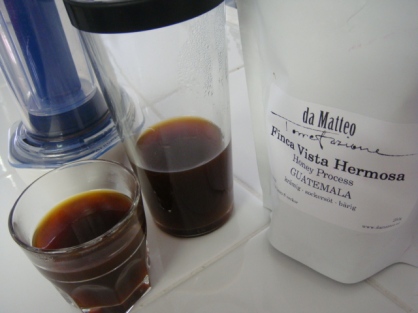
If you aren’t visiting Renato Correia at the Espresso Lab in Cape Town, South Africa in the next few days there are only two places in the world where you can get it. da Matteo in Göteborg, Sweden and Barefoot in Santa Clara, California USA. Above picture stolen with permission from Renato’s flickr, check it out to see a beautiful roastery that is all white – leaving coffee to be the natural focal point. If you do happen to be in SA, Tribeca is currently carrying some fvh as well as El Paternal.
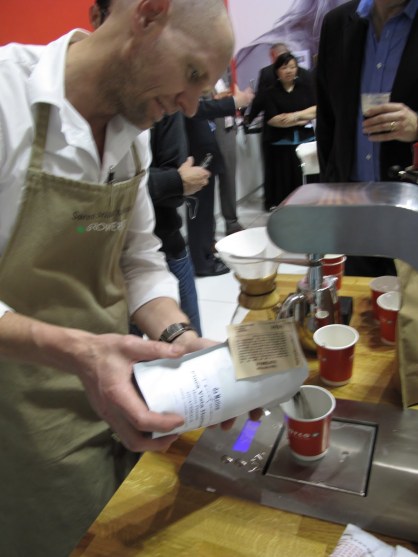
Upon searching through the daMatteo blog I found a photo of Soren Stiller 2008 Danish Barista Champion in Milan last week who seems to be pouring fvh honey whole bean into a cup on a skinny version of the uber boiler’s scale. I don’t know how he finds the time to do this between holding a full time job in Copenhagen, etching Barak Obama in the UK and his Growers Cup side project.
While I love experimenting and am willing to take risks, I also hate to mess up a good thing. Andy Newbom requested we do a honey lot, and so we did. Only because it was Andy. And maybe it is because he has a chef’s personality. Chef in french means BOSS, but in the culinary trade, chef’s tend to be known for being obsessive and sometimes perfectionists. Not sure if Andy is a perfectionist, but he certainly is obsessive about trying something every which way imaginable until discovering something beautiful and perfect. He will be coming back to Guatemala this harvest for the 4th time. My conclusions on our honey is that it yields everything I expected. The acidity is tapered down a bit and their is more body and incredible molasses sweetness. My problem with this is that I think this is attainable with many other coffees around us and giving our coffee a honey process means loosing some of what I like most in our coffee. The sparkling super clean and sweet juicy acidity. While our coffee is mild bodied it is actually refreshing to where you don’t crave something else in between sips, you just want to chug it. Yes, chug it. I must give credit for this descriptor to Ben Kaminsky who on rare occasion is known to refer to a coffee as “chuggable”. While fvh honey is not chuggable, it is a great fit for those with a sweet tooth. Pair this with a nice dry unsweetened buttery pastry. Yes, this is a Guatemalan coffee with enough body to stand up to butter.
Despite adamantly requesting the entire lot, thank you for sharing Andy.
FVH now on Twitter!!!
October 11, 2009
No. Not really. While many are going out of their way to broaden their sphere of influence for business and personal reasons via social networking tools such as facebook, Twitter, linkedin, myspace and more, I’m working my way off the grid. I counted 161 social networking sites listed on wikipedia.org today, which is clearly not a comprehensive list as they somehow missed baristaexchange. Despite the great values offered by these technologies, I have come to appreciate communicating and interacting IN PERSON a great deal. I’m careful to not be too critical of something I’m unfamiliar with, however I’m content being ignorant. That being said, this post was done from my phone
Naturals in Guatemala at FVH!
April 2, 2009
Yes, it is true. After years of hearing roasters say, “I wonder what a natural from your farm would taste like” we finally caved in. Linus Törsäter from The Coffee Collective, Chad from Evo and Madcap along with the crew from BFCT agreed to do some of the work for a very small batch. So they will reap the rewards of their work and if you want to taste this, you’ll have to track one of them down in the coming months because we are only doing about 600 lbs of cherry. This means each of the above will only have enough to do ONE small batch roast to play with. I will have to personally drive the dried natural cherry to a micro mill that has a SCOTTISH or IRISH dry mill to then clean and sort by hand. Dry milling naturals is actually much more work in the the dry mill stage… and of course, potentially much less in the preceding stages.
Jake put together a wonderful video of kids interacting with his beard, some soccer and some coffee.

Photo and video by Jake Liefer. Click on here to see video
La Cosecha!!!
January 26, 2009
Officially the first day of harvest at FVH!!!
60 canastos given out. A canasto is a basket for collecting coffee.
40 cartones issued: A carton is literally a piece of custom printed carton that we use for tracking volume of red cherry picked. Each person that holds a carton is on payroll and they may request additional baskets if they have help. Help is usually immediate family that would rather tag along and be together than be apart both for the day as well as the harvest season. What exactly does this look like? Well this year it means half the people on payrol have a brother, cousin or possibly wife that is helping them. If it is their wife, their kids often are tagging along sometimes being helpful, but mostly being together with family and goofing around among the coffee trees.
We are very fortunate that Lencho and his brother Juan are both with us this harvest to assist Diego. They are very committed to supporting their extended family in the absence of Carlos and Edwin Garcia Martin. They have also expressed continued commitment in ensuring FVH continues strong and they happen to have the financial need. The icing on the cake for everyone is that they both enjoy what they do and they are VERY good at it.
Lencho and Diego went to La Messilla this weekend to buy a new corn mill that will assist Diego in supporting both his wife along with his mother and siblings for many years to come.
Thanks to all of you who have been supporting Juana and her family. We have been diligent to ensure that a little bit goes a long way. We are carefully considering how to best help them as needs arise. We do have a small amount of money set aside remaining for this. If you wish to support them financially you can make a donation through paypal on the top right of this blog, or email if you wish to donate some other form of gift.



 FincaVistaHermosa